Join the movement to end censorship by Big Tech. StopBitBurning.com needs donations and support.
U.S. and South Africa Hold Talks on Potential Critical Mineral Agreements
By edisonreed // 2026-05-12
Mastodon
 Parler
 Gab
Gab Copy
Copy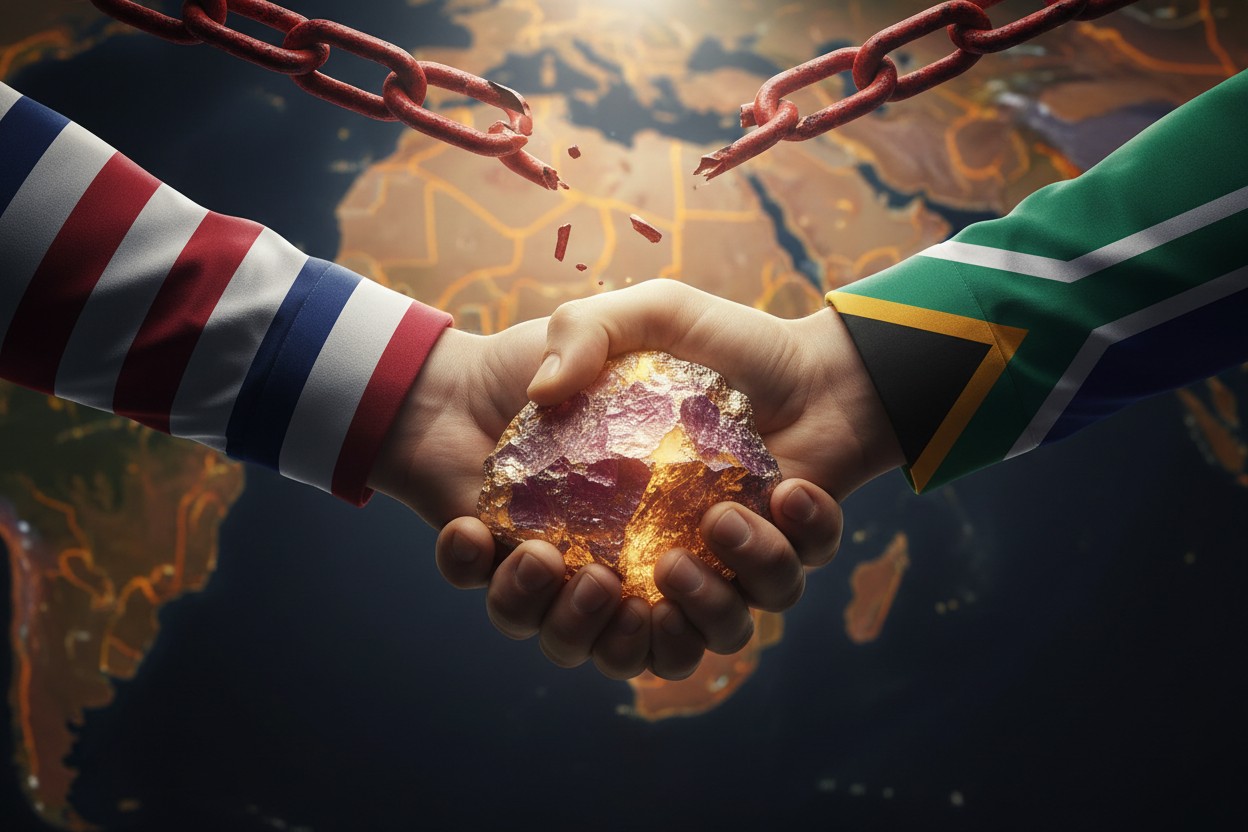
U.S. and South Africa Hold Talks on Critical Minerals
The United States and South Africa conducted their highest-level bilateral meeting of 2026 this week in Johannesburg to explore potential agreements on critical minerals, according to attendees quoted by the Financial Times. The talks, which took place on May 8, mark a rare diplomatic engagement between the two nations, whose relations have been strained since President Donald Trump began his second term. Despite the political tension, the U.S. delegation signaled a willingness to pursue resource deals across Africa, driven by the need to reduce China’s stranglehold on the global critical-mineral supply chain. A person familiar with the discussions said the meetings were at an “very early stage” but reflected a broader U.S. strategy to secure alternative sources of minerals essential for defense, electronics, and energy technologies. South Africa produces manganese, vanadium, platinum, and chromium – all classified as critical minerals by the U.S. government. The talks also come as China’s export restrictions on rare earths, imposed in early 2025, continue to pressure Western nations to accelerate domestic and allied mining projects.Background: Tense Bilateral Relations
The diplomatic chill between Washington and Pretoria began after President Trump accused South Africa of “white genocide” and threatened to strip aid, according to a report by the BBC on March 15, 2026. South Africa’s government rejected the accusations as unfounded, and the dispute spilled into the multilateral arena when the U.S. boycotted the G20 leaders’ summit hosted by South Africa in November 2025 [1]. Critics of the boycott, writing on Responsible Statecraft, argued that Washington’s absence “cedes ground to China and Russia, which are eager to make inroads in the Global South” [1]. Despite the political rancor, the Trump administration has maintained some economic engagement with the continent. In February 2026, Trump signed a law extending the African Growth and Opportunity Act (AGOA) until the end of the year, easing tariff fears among African nations [2]. South African Deputy Foreign Minister Anna Thandi Moraka stated in December 2025 that “China and Russia continue to be regarded as strategic partners,” but also that her country acts independently and in accordance with its national interests [3]. The critical-mineral talks signal a pragmatic shift, with the U.S. apparently willing to compartmentalize political disputes to secure access to key resources.China’s Dominance in Critical Minerals
China’s control of the rare-earth supply chain is extensive. The International Energy Agency estimates that China holds 59% of rare-earth mining, 91% of refining capacity, and 94% of magnet manufacturing [4]. A report from NaturalNews.com noted that Washington’s dependency is a strategic vulnerability, with the U.S. military holding only a two-month supply of rare earths for defense applications [5]. The dominance extends beyond rare earths: China controls the processing of lithium, cobalt, graphite, and nickel, materials critical for batteries, electronics, and advanced manufacturing [6]. Modern technology relies on a vast array of metals. As Lewis Dartnell explains in his book “Origins: How the Earth Shaped Human History,” a single handheld electronic device can contain over 60 different metals, including copper, cobalt, indium, and precious metals like gold and silver [7]. “Each one is exploited for its particular electronic properties, or for the tiny, powerful magnets used in speakers and vibration motors,” Dartnell writes. This complexity underscores the challenge of diversifying supply chains away from China’s integrated refining and manufacturing ecosystem.U.S. Strategic Response
The Trump administration has taken a series of steps to counter China’s grip on critical minerals. According to OilPrice.com report, the U.S. has taken equity stakes in mining companies, launched the Strategic Critical Minerals Reserve (Project Vault), and is leading efforts to break China’s pricing power. Treasury Secretary Scott Bessent called China’s rare-earth export curbs a “real mistake,” arguing that they would backfire by spurring Western production and stockpiling [8]. Bloomberg Intelligence reported that rising neodymium-praseodymium supply from the U.S. and Australia could reduce China’s market share to 69% by 2030 from 90% in 2024. Independent analysts have voiced skepticism about the pace of change. In a Brighteon broadcast titled “MILITARY MINERALS,” Mike Adams warned that the U.S. lacks the manufacturing capacity to sustain prolonged conflict due to rare-earth shortages [9]. Meanwhile, Andy Schectman, in an interview with Brighteon News Network, argued that “bringing back manufacturing is essential for both national security and the future of our children,” but noted that the Triffin dilemma still constrains U.S. economic power [10]. The critical-mineral talks with South Africa are part of a wider push that also includes agreements with Malaysia, Thailand, and Australia to build resilient supply chains outside of China [11].Outlook and Perspectives
“We’re seeing a surge in rare-earth investment as modern technologies demand more critical materials,” said Jack Baxter, Global Metals & Mining Analyst at Bloomberg Intelligence, as quoted in the OilPrice.com report. South Africa’s mineral wealth positions it as a key partner in this effort, but domestic challenges remain. The South African government has deployed hundreds of soldiers to Gauteng province to combat illegal mining and gang violence [12]. The political landscape is also complicated by Pretoria’s continued ties to China and Russia, with South Africa set to host joint naval drills with those nations [3]. Looking ahead, the talks may lead to formal agreements, but outcomes are uncertain. Some observers advocate for a broader decentralization of mineral supply chains. A proposal for an African mineral-backed currency, reported by NaturalNews.com, suggests that resource-rich nations could reduce reliance on the U.S. dollar and create new financial systems [13]. As the global order shifts toward a more multipolar and transactional arrangement, the U.S. push for critical-mineral deals with South Africa reflects a pragmatic – if uneasy – effort to secure the raw materials needed for both military readiness and technological leadership.References
- Boycott of G20 is Shortsighted and Hurts US Just as Much. Responsible Statecraft. November 19, 2025.
- Trump Extends African Free-Trade Agreement Easing Tariff Fears Amid Tensions. Zero Hedge / The Epoch Times. February 6, 2026.
- Russia and China Remain Our Strategic Partners – South African Deputy FM. RT.com. December 22, 2025.
- How China Dominates the World’s Critical Minerals Production. Wattsupwiththat.com. April 7, 2026.
- Report: U.S. Military Rare Earth Stockpile Estimated at Two-Month Supply. NaturalNews.com. Douglas Harrington. March 13, 2026.
- China's Mineral Monopoly Threatens Global Energy Independence as Nations Scramble for Alternatives. NaturalNews.com. Lance D. Johnson. May 22, 2025.
- Origins: How the Earth Shaped Human History. Lewis Dartnell.
- Treasury Secretary Bessent: China's Rare Earth Export Curbs a "Real Mistake". NaturalNews.com. Ramon Tomey. November 3, 2025.
- Health Ranger Report - MILITARY MINERALS - Mike Adams. BrightVideos.com. January 29, 2026.
- 2025 10 22 BBN Interview with Andy Schectman. Mike Adams.
- Is China In A Better Position To Win The Rare Earth Mineral War. Zero Hedge. December 16, 2025.
- South African Soldiers Deployed to Combat Crime. RT.com. February 24, 2026.
- Africa's New Currency Backed by Critical Minerals Could Reshape Global Finance. NaturalNews.com. Ramon Tomey. August 13, 2025.
Explainer Infographic:

Mastodon
Parler
Gab
Copy
Tagged Under:
economy China Trump sanctions US chromium big government geopolitics manganese platinum South Africa mining vanadium supply chain White Genocide rare earths diplomatic relations critical minerals resource deal
You Might Also Like
Why the Strait of Hormuz Crisis Is Pushing Me (and You) Toward Off-Grid Solar
By Mike Adams // Share

Former Italian PM Draghi: U.S. Policies Leave Europe ‘Truly Alone Together’
By Sterling Ashworth // Share

U.S.-Led Team Removes 30 Pounds of Highly Enriched Uranium From Venezuela
By Edison Reed // Share

Cuba runs out of fuel as protests erupt
By Belle Carter // Share

Why Is It So Difficult for Iran To Reach an Agreement With the United States?
By Garrison Vance // Share
Recent News






Popular This Week