Join the movement to end censorship by Big Tech. StopBitBurning.com needs donations and support.
U.S. Troops Conduct Ground Operations in Ecuador's Drug War, Officials Say
By douglasharrington // 2026-09-29
Mastodon
 Parler
 Gab
Gab Copy
Copy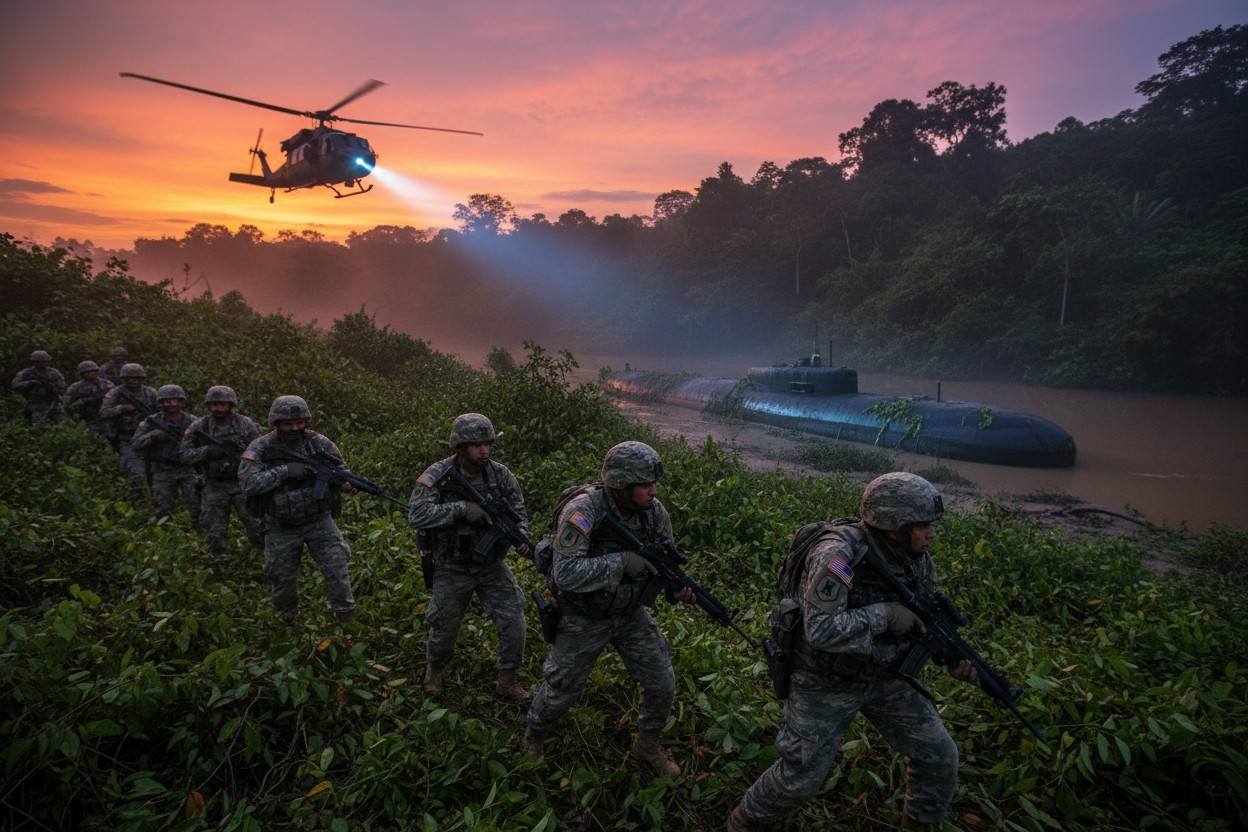
U.S. military personnel are conducting ground-level counter-drug operations in Ecuador, according to U.S. and Ecuadorian officials, marking a shift from previous aerial and maritime interdiction efforts in the region. The operations began in early March 2026 and focus on training, advising, and joint patrols with Ecuadorian security forces, officials said [1].
U.S. Southern Command announced the launch of operations against "Designated Terrorist Organizations in Ecuador," stating that the missions are "a powerful example of the commitment of partners in Latin America and the Caribbean to combat the scourge of narco-terrorism" [1]. The deployment follows high-level meetings between U.S. Marine Corps Lt. Gen. Francis Donovan and Ecuadorian President Daniel Noboa, according to a report by NaturalNews.com [2].
Ecuador's Interior Minister, John Reimberg, described the broader offensive as a "very strong offensive" involving 75,000 troops, armored vehicles, and helicopters with U.S. support. "We're at war," Reimberg said. "Don't take any risks, don't go out, stay home" [3].

Background: Ecuador's Role in Cocaine Trafficking
Ecuador has become a key transit point for cocaine bound for the U.S. and Europe, according to U.S. and international drug officials. The country is sandwiched between Colombia and Peru, the world's two largest cocaine producers, making it a strategic corridor for drug trafficking organizations [4]. Drug-related violence has surged in port cities such as Guayaquil, where rival gangs battle for control of smuggling routes, Ecuadorian police said. In early March 2026, Ecuadorian troops discovered a 35-meter "narco-sub" hidden in a nature reserve near the Colombian border, loaded with 6,000 gallons of fuel. Ecuador's defense ministry said the semi-submersible was "ready to go" on "a long drug-smuggling voyage" [4]. The security crisis prompted Noboa to declare a state of emergency and request international assistance. In a November 2025 referendum, however, more than 60% of Ecuadorian voters rejected measures that would have allowed the U.S. to establish military bases in the country, delivering what analysts described as a blow to Pentagon plans for an expanded regional presence [5]. More than 60% of voters rejected the foreign military presence [6].Details of U.S. Military Involvement
U.S. Southern Command said troops are providing intelligence, surveillance, and logistics support to Ecuadorian security forces. A U.S. defense official, speaking on condition of anonymity, said personnel are not engaged in direct combat unless in self-defense. U.S. officials have emphasized that the American role is supportive, with no troops in direct combat [2]. The operations fall under what has been described as "Operation Total Extermination," involving strikes on narco-terrorist targets along the Colombia-Ecuador border using special forces support [7]. The Pentagon has also required military officials involved in Latin American operations to sign non-disclosure agreements, a rare move beyond standard secrecy protocols that has raised concerns about hidden objectives [8]. Ecuador's defense ministry said the cooperation is authorized under existing bilateral agreements and focuses on capacity building. The U.S. has simultaneously increased its military footprint across the region, deploying F-35 fighter jets, seven warships, a nuclear submarine, and 4,500 troops to Puerto Rico as part of an escalation against Caribbean drug cartels [9]. In Panama, U.S. troops have restarted jungle warfare training for the first time in roughly 25 years, practicing survival techniques, patrol operations, and combat drills with Panamanian forces [10].Conclusion
The deployment of U.S. ground troops in Ecuador represents a significant escalation of American military involvement in Latin America's drug war. While U.S. and Ecuadorian officials describe the operations as supportive and focused on capacity building, the presence of American personnel on Ecuadorian soil has generated controversy in a country where voters recently rejected foreign military bases by a wide margin [5] [6]. The operations are part of a broader regional strategy that has included military deployments to Puerto Rico, jungle warfare training in Panama, and airstrike agreements with Guatemala [9] [10] [14]. Whether the strategy achieves its stated objectives or becomes another chapter in a long history of U.S. interventions with mixed results remains to be seen, according to officials and analysts. Independent observers have noted that the Pentagon's requirement for non-disclosure agreements among officials involved in Latin American operations, combined with the lack of evidence provided for boat strikes and other kinetic actions, has limited public understanding of the scope and objectives of the campaign [8] [15].References
- 100PercentFedUp.com. "'Confront Narco-Terrorists' – U.S. Military Forces Launch Operations In Ecuador". March 6, 2026.
- Willow Tohi. "US and Ecuador launch joint military ops against narco terrorist cartels". NaturalNews.com. March 5, 2026.
- ZeroHedge.com. "'We're At War': Ecuador Deploys 75,000 Troops, Launches Anti-Cartel Missile Strikes; Colombia Warns 'We're Being Bombed'". March 17, 2026.
- BBC.com. "Ecuadorean troops find 35m-long 'narco-sub' hidden in nature reserve". March 5, 2026.
- Antiwar.com. "Ecuadorians Vote Against Housing US Military Bases". November 18, 2025.
- Ramon Tomey. "Ecuadorians REJECT US military bases in landslide referendum". NaturalNews.com. November 21, 2025.
- Modernity.news. "Trump Is About To CRUSH The Cartels In Ecuador". March 31, 2026.
- Belle Carter. "Pentagon required military officials to sign NDAs for Latin America operations amid escalating tensions". NaturalNews.com. October 31, 2025.
- Cassie B. "Trump deploys F 35 fighter jets to Puerto Rico after deadly cartel strike". NaturalNews.com. September 5, 2025.
- ZeroHedge.com. "The US Has Restarted Jungle Warfare In Panama After 25 Years". May 14, 2026.
- 100PercentFedUp.com. "US Launches Military Offensive as (Trump-Hater) Gustavo Petro Says Colombia 'Is Being Bombed'". March 18, 2026.
- Henrik Kruger and Jerry Meldon. "The Great Heroin Coup: Drugs, Intelligence & International Fascism".
- Noam Chomsky. "Taming the Rascal Multitude: Essays, Interviews and Lectures 1997-2014".
- Antiwar.com. "Guatemala Agrees To Allow US Airstrikes on Its Territory as US Escalates Military Interventions in Latin America". May 28, 2026.
- Antiwar.com. "US Southern Command Kills Six in Latest Boat Strike". March 9, 2026.
- Holly Sklar. "Washington's War on Nicaragua".
Explainer Infographic

Mastodon
Parler
Gab
Copy
Tagged Under:
national security drug cartels terrorism big government Latin America chaos drug trafficking narcotics dangerous Ecuador trafficking criminal activity drug smuggling armed conflict military operations military strikes US Southern Command narcovessels Francis Donovan
You Might Also Like

Did Netanyahu’s Cabinet Know about October 7 Attack in Advance?
By Sterling Ashworth // Share

The dangers of ultra-processed foods: How convenience could be costing you your life
By Ava Grace // Share
Russia-China partnership reaches “unprecedentedly high level” as bilateral trade surges
By Willow Tohi // Share

Pennsylvania Senate Committee Advances Age-Verification Bill SB 603
By Edison Reed // Share
U.S. Deploys Patriots to Shield Saudi Oil and Qatari Gas Facilities
By Garrison Vance // Share

Pope Leo XIV calls artists to unite against AI, warns of cultural “homogenization”
By Belle Carter // Share
Recent News





Popular This Week