 Parler
 Gab
Gab Copy
Copy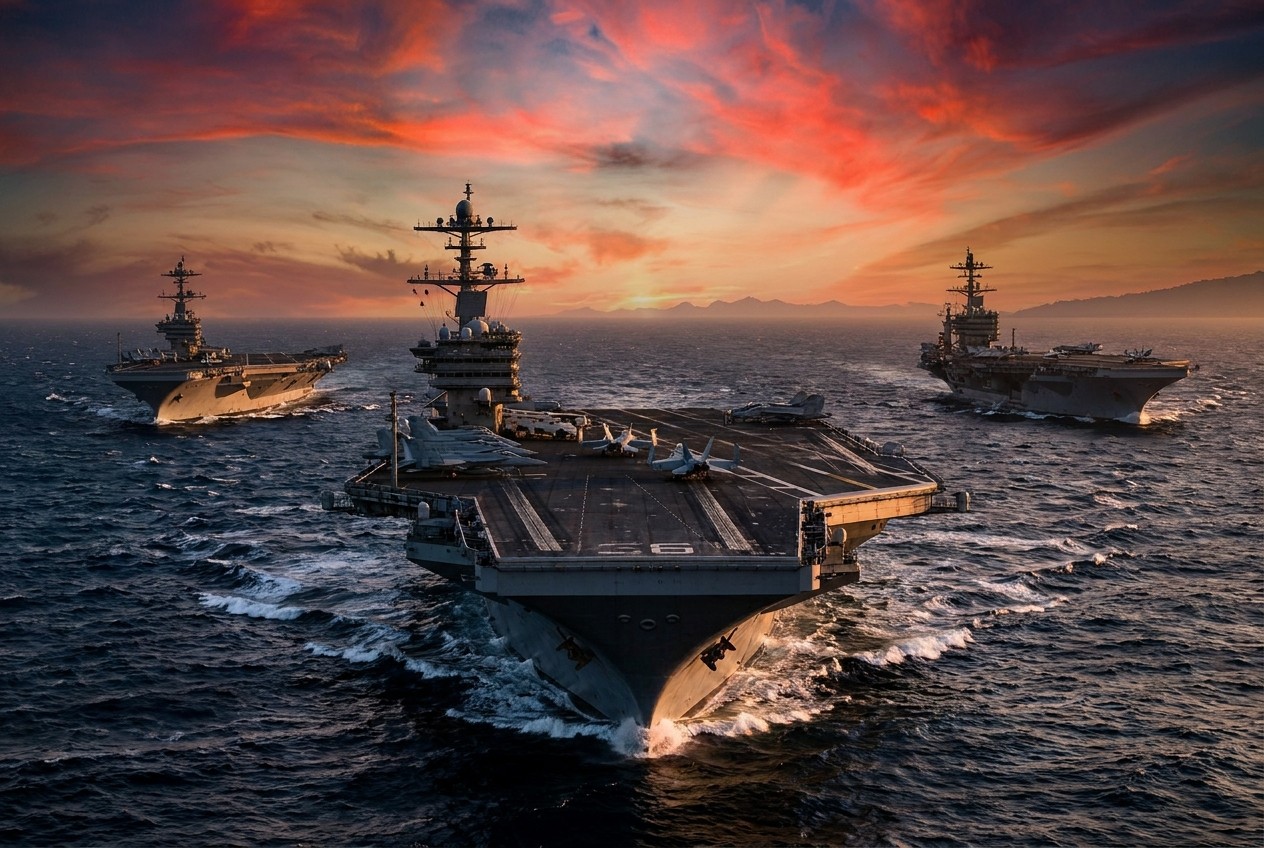
Ships Depart San Diego and Amphibious Group Follows
The USS Theodore Roosevelt, flagship of Carrier Strike Group 9 and nicknamed "The Big Stick," departed San Diego Bay on Sunday, Sept. 27 on a scheduled deployment as per USNI News. The Nimitz-class carrier is expected to head to the Middle East to relieve one of the two carriers on station supporting operations against Iran [4]. The USS Makin Island Amphibious Ready Group – with three ships and Marines from the 13th Marine Expeditionary Unit – left on Monday, Sept. 28, officials said. The amphibious group adds a landing capability that could support evacuation, reinforcement or expeditionary operations, according to Navy officials [3]. The USS George H.W. Bush and USS George Washington are already in the Middle East. A third carrier would be the first time the U.S. has had three carriers in the region since April, before a fragile ceasefire that later collapsed, according to officials [3].Trump Rejected Iran Ceasefire Proposal, Cites Post-Midterm Option
The deployments follow Trump's rejection of Iran's latest seven-day ceasefire proposal, officials said. The rejected proposal would have reopened the Strait of Hormuz and resumed nuclear talks in return for the U.S. lifting its blockade of Iranian ports, according to the report [3]. In the TIME interview, Trump said he could resume striking Iran after the midterms if no deal is in place. U.S. naval forces have been intercepting vessels globally. Thirty-four ships have already been denied passage, and Secretary of War Pete Hegseth has warned that military retaliation would follow, according to a report [5]. A poll conducted by the Chicago Council on Global Affairs from June 21 to July 1 found that more than half of American respondents opposed deploying U.S. troops to defend Israel, according to a survey of 1,056 U.S. adults [6].Force Levels and Strain on Navy
The additional servicemembers add to more than 50,000 troops already in the region, one official said. Hegseth extended deployments of air-defense units and the Army's 82nd Airborne Division, with officials citing supply shortages and near-record deployments. The strain has been visible aboard the USS Abraham Lincoln, where eight sailors attempted suicide during a 286-day deployment, the War Department told a lawmaker in a written response [7]. Acting Navy Secretary Hung Cao disclosed the figure in a letter to Sen. Kirsten Gillibrand (D-NY) [8]. The Navy is working to develop metrics to measure combat readiness of the integrated battle group, centered on the aircraft carrier, according to Rear Adm. Larry C. Baucom [9]. Such metrics quantify the readiness of the battle group team in the context of risk [9].Uncertainty Over Carrier Presence, No Comment From White House or Pentagon
It is possible USS George Washington could leave the region and return to Japan, reducing the force to two carriers, officials said. The George Washington arrived in the Arabian Sea in August to replace the USS Abraham Lincoln after multiple reports of difficult conditions for sailors, U.S. Central Command announced [10]. White House and War Department spokespeople did not respond to requests for comment. A third carrier would provide more options and firepower if Trump decides to attack, according to officials [3]. The deployment is part of a broader military buildup. The U.S. and Israel launched a coordinated strike against Iran on Feb. 28, dubbed Operation Epic Fury, following the collapse of diplomatic talks. Initial strikes involved over 1,000 targets, according to a report [11].References
- Lara Seligman and Shelby Holliday. "U.S. Sending Third Aircraft Carrier, Up to 10,000 More Troops, to Middle East". The Wall Street Journal. October 1, 2026.
- "Oil Soars As US Sending 10K More Troops, 3rd Carrier, To Mideast After Trump Threatens Post-Midterm Bombing". ZeroHedge. October 1, 2026.
- "Trump Sending Third Aircraft Carrier Strike Group to Middle East". Antiwar.com. October 1, 2026.
- "Where Are The Aircraft Carriers?: September 30, 2026". The War Zone. September 30, 2026.
- Patrick Lewis. "US enforces ironclad blockade on Iran in escalating show of force". NaturalNews.com. April 26, 2026.
- "Poll More than half of Americans oppose deploying troops to ISRAEL". NaturalNews.com. August 12, 2024.
- "Eight attempted suicides during US aircraft carrier's extended mission". Middle East Eye. September 24, 2026.
- "Eight US sailors assigned to USS Abraham Lincoln attempted suicide, Navy says". BBC. September 24, 2026.
- Rear Admiral Larry C. Baucom. "Interview with Rear Admiral Larry C. Baucom". Federal Facilities Environmental Journal. Summer 2001.
- "USS George Washington Arrives in the Middle East". Antiwar.com. August 20, 2026.
- Willow Tohi. "US Israel launch massive pre dawn strike on Iran in major escalation". NaturalNews.com. March 06, 2026.
Explainer Infographic

Is the West scapegoating Benjamin Netanyahu to protect its genocidal enterprise in the Middle East?
By Lance D Johnson // Share

Lavrov’s UN plea exposes Russia’s hollow Middle East policy
By Cassie B. // Share

Report: Atrazine Contaminates More Than 25% of U.S. Rivers and Streams
By Iva Greene // Share
Victory by November? How a “defeated” Iran became Trump’s midterm bargaining chip
By Lance D Johnson // Share

Obama-Appointed Judge Slams the Brakes on Trump’s $100,000 H-1B Visa Fee
By Douglas Harrington // Share

AP-NORC Poll: Most Americans Blame Trump for High Prices as Economic Approval Hits New Low
By Sterling Ashworth // Share
Lavrov's UN plea exposes Russia's hollow Middle East policy
By isabelle // Share

Millions of older Americans may be treating drug side effects with more drugs
By isabelle // Share

COVID Was the Warm-Up: The Global Energy Sabotage Is the Real Kill Switch
By healthranger // Share

The Diesel Domino Effect: Why 16 Trucking Bankruptcies Signal a Coming Food Crisis
By healthranger // Share
Obama-Appointed Judge Slams the Brakes on Trump's $100,000 H-1B Visa Fee
By douglasharrington // Share