 Parler
 Gab
Gab Copy
Copy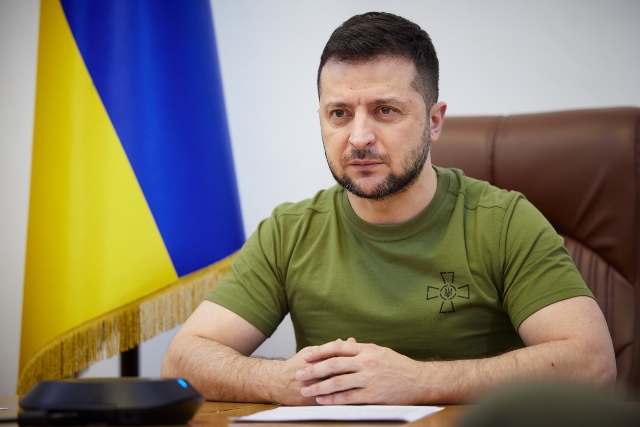
- Ukraine’s presidential election, due in spring 2024, has been postponed under martial law, which Zelensky says extends his term.
- In July 2025, Zelensky signed a law curbing the independence of the anti-corruption agencies NABU and SAPO, then reversed course after street protests.
- Axios reported that the move followed raids on the agencies and the arrest of activist and Zelensky critic Vitaliy Shabunin.
- A $100 million energy-sector kickback scheme tied to Zelensky’s former business partner Timur Mindich preceded the November 2025 resignation of chief of staff Andriy Yermak.
- Russia’s OSCE envoy, Dmitry Polyansky, says Zelensky ignores the welfare of the Ukrainians.
A mandate frozen in time
Ukraine’s last presidential vote came in 2019, when Zelensky, a television comedian, swept to power promising to break the oligarchic habits that had defined the country since independence. His five-year term would have ended May 20, 2024, had Russia’s full-scale invasion on Feb. 24, 2022, not triggered martial law. The Martial Law Act explicitly bans presidential, parliamentary and local elections, and parliament has renewed the arrangement in 90-day increments ever since. Zelensky defends this plainly. “My five-year term is not over yet,” he told Reuters in 2024, adding that it continues because of martial law. Many constitutional lawyers agree, and a Kyiv International Institute of Sociology poll early that year found 69 percent of Ukrainians wanted him to stay until martial law lifts. Still, analysts at the Carnegie Endowment note the constitution is vague, setting five-year terms in one article while letting a president serve until a successor is elected in another. Legal defensibility is not democratic health. A pause makes sense when voters are scattered across front lines and exile, yet an indefinite one, controlled by the office that benefits from it, invites suspicion. President Donald Trump has echoed Moscow’s call for a vote. Zelensky says he will hold one, but wants a ceasefire first.Watchdogs, scandals and a winter of consequence
Elections are one check on power. Independent investigators are another, and here critics see the clearest evidence of Zelensky's self-protection. NABU and SAPO, the country’s anti-corruption bureau and specialized prosecutor, were formed in 2015 after the Maidan uprising toppled a Moscow-friendly president, and were shaped in close coordination with the European Union and the United States. On July 22, 2025, Zelensky signed a law curtailing their independence. Axios reported that his office pushed the bill through parliament after raids on the agencies and the arrest of Vitaliy Shabunin, a prominent activist and Zelensky critic. The Center for European Policy Analysis said it would effectively place the bodies under the Prosecutor General’s Office, a structure widely viewed as controlled by the presidency. The first mass demonstrations since the invasion followed. Within days, Zelensky submitted legislation restoring their autonomy. The reversal mattered, but so did what came next. In November 2025, investigators alleged a criminal group had embezzled $100 million from the energy sector, a scheme tied to Timur Mindich, a former Zelensky business partner. Several officials were dismissed. After agents searched his office on Nov. 28, chief of staff Andriy Yermak resigned. Ukrainska Pravda has reported that Yermak, Prosecutor General Ruslan Kravchenko and a lawyer took part in a “special operation” to gut the agencies’ independence. Moscow now seizes on this record. Dmitry Polyansky, Russia’s ambassador to the OSCE, told the group in Vienna that Zelensky “doesn’t give a damn about his citizens,” and is preoccupied with the “corruption system of his creation,” as cited by TASS. He spoke after Moscow Mayor Sergey Sobyanin said Ukraine fired 650 drones toward the capital, killing two people, and after Russia’s Defense Ministry promised intensified strikes on Kyiv and other regions. The corruption record does not come from Moscow; it comes from Ukraine’s own investigators, its journalists and Western analysts, and it lands as Russian officials predict an energy and transport collapse before winter. A leader who has avoided the ballot box cannot be trusted to oversee the investigators closing in on his friends. Sources include: RT.com Axios.com CEPA.org
The French Freezer Hack Wasn’t Really a Cyberattack … It Was an Invitation
By Mike Adams // Share
The Age of Incompetence: We’re Now Living Through a Collapse of Reason
By Mike Adams // Share
Trump Dismisses Reports of Chinese and Russian Support for Iran Despite U.S. Intelligence Findings
By Belle Carter // Share

Hidden Recording Device Found in OpenAI Office, Saudi National Arrested
By Douglas Harrington // Share
Top Oil CEOs Flee Saudi Summit Following Houthi Strikes on Kingdom
By Garrison Vance // Share
China Thermal Coal Prices Hit Three-Year High as Domestic, Imported Supply Tightens
By Sterling Ashworth // Share
To Grow Food, Build Soil—Not Gardens: What William Bond Taught Me About Permaculture
By healthranger // Share
The Age of Incompetence: We're Now Living Through a Collapse of Reason
By healthranger // Share
The French Freezer Hack Wasn't Really a Cyberattack ... It Was an Invitation
By healthranger // Share
Hidden Recording Device Found in OpenAI Office, Saudi National Arrested
By douglasharrington // Share
North Korea confirms tactical missile upgrade in new provocative launch
By willowt // Share